
If you're searching mobile home setup near me, you've got a home that needs to land — a new unit staged on a lot, a park lot turnover waiting on a tenant, or a replacement after a relocation — and you want a crew that owns the whole set, not just part of it. A manufactured home doesn't drop onto a slab and call it done; the set is a licensed craft with its own permits, tolerances, and inspection. Mobile Home Mover Pro provides mobile home setup across North Carolina and South Carolina as a single continuous job — the same crew that positions the home blocks it, levels it, bolts up the marriage line, and ties it down, so there's no hand-off where details get dropped. Send the unit type, the pad status, and the county, and we quote the set in writing within 24 business hours.
Pier blocking: the foundation built under the chassis
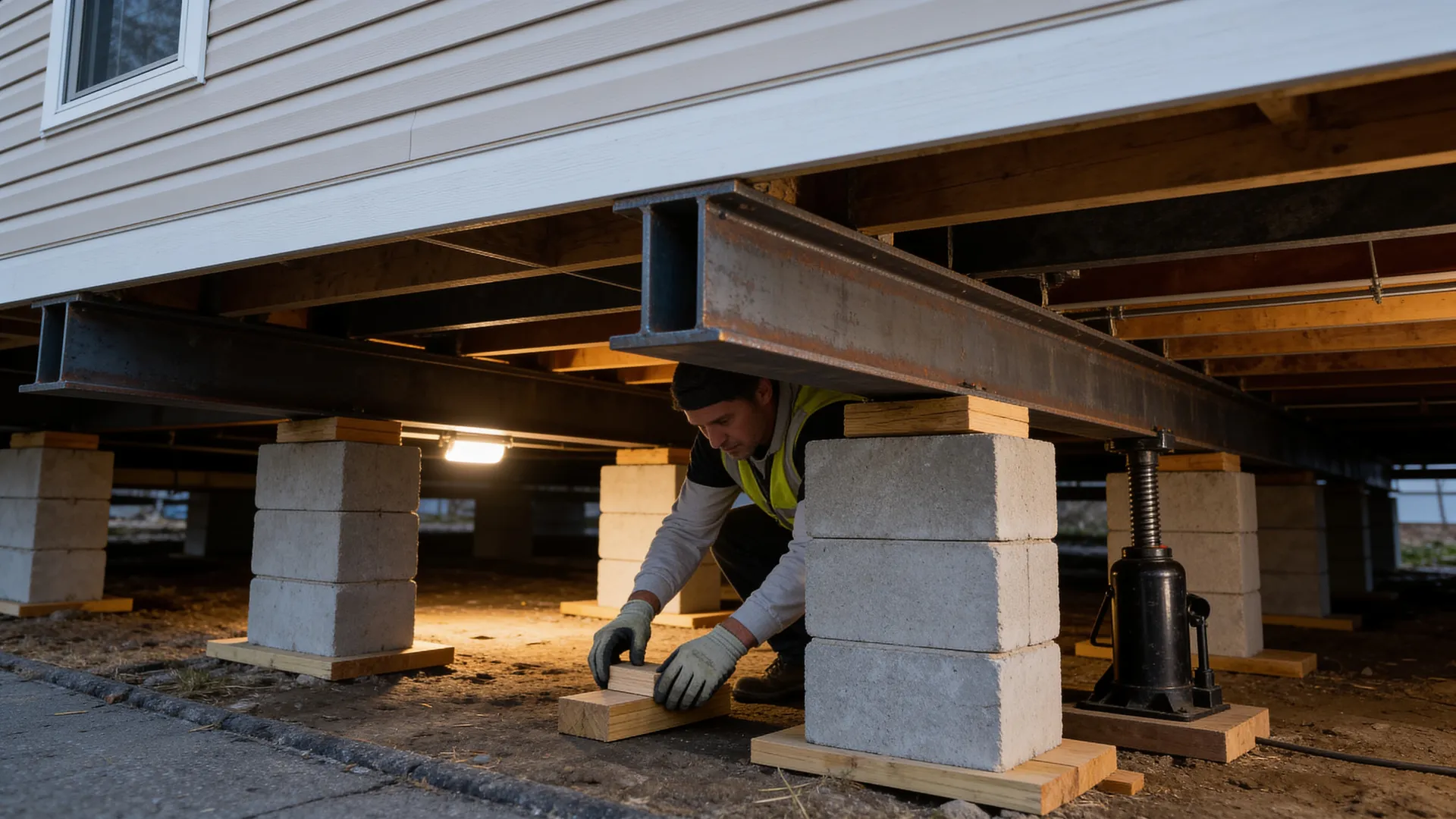
The set starts under the floor. A manufactured home rides on two or more steel I-beams, and those beams have to land on a pier system that transfers the whole weight of the house into solid bearing. We build piers from stacked 8x16-inch concrete block on a poured or precast footing pad, sized so the soil isn't overloaded — that matters more than people expect in the soft, sandy soils of the SC Pee Dee and the NC Coastal Plain, where an undersized footing punches into the ground and the home settles unevenly within a year. Piers go under each I-beam at the spacing the home's manufacturer installation manual specifies, usually every 8 to 10 feet, with added piers at the marriage line, under wide wall openings, and beneath heavy point loads like a masonry fireplace. Get the pad and piers right and everything above stays true; get them wrong and no amount of later shimming fixes it. If the pad itself needs building, that runs through our pads, footers & piers service on the same visit.
Leveling to a quarter inch — and why it isn't optional
Once the piers are stacked, the home gets leveled — the tolerance step that separates a professional set from a quick block-and-go. Using hardwood shim plates and wedge pairs on top of each pier, we bring the chassis true to within roughly 1/4 inch across its full length and width, checking with a long level and a water or laser line, not by eye. That precision isn't cosmetic. A frame that sits out of level by even half an inch racks the structure: interior doors won't latch, windows bind, drywall seams crack at the corners, and the roof can pond water at the low end. A home set dead-level on day one will still read level years later; one set sloppy needs a re-level service call before the first winter. After leveling, the perimeter is blocked and the frame is locked before any straps go on or the mobile home skirting closes in the crawl space.
HUD Wind Zone anchoring: tie-downs rated to where you live
Leveling holds the home up; anchoring keeps it from moving sideways or lifting in a storm — and the federal standard scales the requirement to your geography. Under HUD 24 CFR 3280 Subpart G, every manufactured home is built for and must be anchored to a designated Wind Zone. Most of inland North Carolina and South Carolina — the WNC mountains, the Piedmont, the Upstate, the Midlands — is Wind Zone I, engineered to resist roughly 70-mph design wind. The coastal counties shift up: the SC coast around Myrtle Beach and Conway, and the NC coast near Wilmington, are Wind Zone II, built and anchored to roughly 100-mph design wind. The practical difference is in the hardware — a Zone II coastal set demands more frequent auger anchors, heavier frame-tie straps, and over-the-top straps that pass across the roof to resist overturning. A home built to Zone II that's anchored as if it were Zone I is not legally set and won't survive a named storm, which is why we verify the data-plate Wind Zone against the install county before a single anchor goes in. The full tie-down spec lives on our mobile home anchoring page.
How the set fits with the haul, the move, and the inspection
A set is the far end of every relocation — a home is never truly "installed" until it's blocked, leveled, and anchored on the new pad. That's why the set is a line item in any mobile home transport job, and why booking the haul and the set as one job means one crew, one mobilization, and one number rather than a toter company handing off to a set crew that shows up a week later. When you need the whole relocation rather than just a set, our mobile home movers near me page covers the full move, and the licensed mobile home movers page walks through the credentials the trade requires. Once the home is level, joined, and anchored, we complete the utility crossovers and confirm the set against the manufacturer's manual for the local building inspector, who checks pier spacing, leveling, anchoring, and connections before a certificate of occupancy is issued. The complete multi-section version — haul plus set plus bolt-up — is on our manufactured home installation page.
Setup across North Carolina and South Carolina
Where the home lands shapes how it's set. In North Carolina, the heavy clay of the Piedmont and the WNC mountain coves swells wet and shrinks dry, so footings have to be sized and drained for it, while the sandy coastal-plain counties east of I-95 need engineered pads to carry concentrated pier loads. Across the line in South Carolina, the Midlands and the Pee Dee bring their own clay-and-sand mix. North Carolina enforces manufactured-home installation through the NC Office of State Fire Marshal's manufactured building program, and South Carolina licenses installers through the SC LLR Manufactured Housing Board — the same regulatory backbone behind our transport and leveling work, and the reason "who's licensed to do this" is a fair question to ask any crew. We set homes in both states, and you can see setup work by county in Harnett County, NC, Lincoln County, NC, and Spartanburg County, SC, among others.
Get a local setup quote — the fast way
You don't have to have hired us for the move to have us set the home. A large share of our set calls are homes a dealer delivered, a park needs turned over, or an owner bought to relocate onto their own land. The fastest way onto the schedule is to send the details up front so we can size the job before rolling a truck: put the unit type, the pad status (fresh site or existing footing), and the county the home sits in on the form, and Mobile Home Mover Pro returns a written setup quote inside 24 business hours. Home blocking a dealer lot, a tenant waiting on a park turnover, or a replacement timeline bearing down? Flag it as urgent and we prioritize the routing.