
North Carolina · NCDOT MH-2 · NCGS 105 · NC OSFM set-up

North Carolina Mobile Home Moving Laws

Every rule that governs putting a manufactured home on a North Carolina road and setting it down legally — the oversize permit, the county tax permit, the set-up license, titling, and the zoning age caps that decide where it can land.

Licensed & insured · NC & SCNCDOT-certified escorts24-hour written quoteOne crew, start to finishPermits pulled in every county Licensed & insured · NC & SCNCDOT-certified escorts24-hour written quoteOne crew, start to finishPermits pulled in every county

Get a free quote

Back within 24 hours — no obligation.

Goes straight to our crew. We never sell or share leads.

Quick answer
What does North Carolina law require to move a mobile home?
North Carolina requires a state oversize trip permit under the NCDOT Publication MH-2 rules plus a county tax-paid moving permit under NCGS Chapter 105, Article 18 — the county won't release the home until taxes are paid. Movement is sunrise-to-sunset only and stops in unsafe weather, escorts scale with width, the set-up must meet NC OSFM installation standards and pass inspection, and local zoning age caps govern where the home can be placed.
North Carolina mobile home moving laws at a glance — sourced to the NC General Statutes (NCGS Chapter 105 Article 18, NCGS 20-109.2, NCGS 160D-910), NCDOT Publication MH-2, and the NC Office of the State Fire Marshal Manufactured Building Division. Width thresholds, travel hours, and escort and permit rules are drawn from those authorities; confirm current fees, weather rules, and county ordinances on the permit and with the relevant office before a move.
RequirementNorth Carolina rule & governing authority
Governing law / statute Moving a manufactured home is unlawful without a county tax permit under NCGS Chapter 105, Article 18 (§ 105-316.1 et seq.); the haul itself is authorized under the NCDOT Publication MH-2 oversize-permit rules. Authority: NC General Assembly; NCDOT.
County moving permit (+ property-tax requirement) A tax permit from the county tax collector is required before a home can be removed, and no permit issues until all taxes, penalties, and interest owed on the home are paid; the permit must be displayed near the license tag on the rear during transport. Repossessing lien-holders may obtain a permit without prepaying, then pay within 7 days (nonresidents pay up front). Authority: NCGS 105-316.1 & 105-316.4; county tax office.
DOT oversize / overdimensional permit A single-trip oversize permit issued under NCDOT Publication MH-2 sets the legal route, escorts, and travel window by the load's width. Authority: NCDOT Oversize/Overweight Permit Unit.
Escort requirements Under MH-2 the escort count scales with width: a 12-foot-wide home needs no escort unless the permit specifies one, a 14-foot home runs one or two escorts depending on the highway, and a 16-foot home requires two escorts on all highways. Any escort vehicle operator must hold an approved NC escort certification, and over-height loads exceeding 14'5" require a front pole-car escort. Authority: NCDOT Publication MH-2 & Escort Publication E-9.
Movement restrictions (hours / wind / holidays) Movement is sunrise-to-sunset only: 12- and 14-foot units may travel Monday–Saturday, sunrise to sunset, and 16-foot-wide units are limited to Monday–Saturday 9:00 AM–2:30 PM. Travel stops in unsafe weather, and oversize movement is restricted around major holidays under NCDOT's permit rules. Authority: NCDOT Publication MH-2; NCDOT Oversize/Overweight Permit Handbook.
Set-up & installer licensing authority Installing/setting a manufactured home is regulated work requiring a state set-up contractor license (application, exam, and surety bond), and the finished set is inspected to the State of NC Regulations for Manufactured Homes before occupancy. Authority: NC OSFM Manufactured Building Division.
Title / real-property conversion A home permanently affixed to land can have its certificate of title surrendered and cancelled so the home is treated as real property; the affidavit is recorded with the county register of deeds. A title cancelled to the land must be addressed before the home is road-legal again. Authority: NCGS 20-109.2; NCDMV.
Age & zoning limits at destination Siting is local zoning, not transport law. An age cap by itself is impermissible, but counties and towns may require HUD-Code (post-June 15, 1976) construction and confine homes to certain districts — many bar pre-1976 units outright. Authority: NCGS 160D-910; UNC School of Government; county zoning ordinances.

North Carolina mobile home moving laws sit in three layers that have to be satisfied in order: the road, the tax office, and the destination. Get any one wrong and the move is illegal, uninsured, or dead on arrival when the county won't let you set the home. This guide walks each layer the way the state actually enforces it — what permit covers the haul, what clears the home to leave its parcel, who's licensed to set it down, and what local rule decides whether it can be placed where you're sending it. Mobile Home Mover Pro owns this whole chain so the paperwork is filed in the right order, on the right day — from the mountains around Boone and Hendersonville to the Sandhills near Fayetteville and the coast.

The road: NCDOT Publication MH-2 oversize permit

A manufactured home travels as an oversize load, and the authority to move it comes from a state trip permit issued under the NCDOT Publication MH-2 mobile and modular home permit rules. That permit does more than grant permission — it sets the terms of the haul. Movement is restricted to sunrise-to-sunset hours, the widest homes are held to a tighter weekday window (a 16-foot-wide home runs 9:00 AM–2:30 PM, Monday–Saturday), and the move stops in unsafe weather — high wind especially, because a wide, flat-sided home behaves like a sail. The permit also fixes the approved route to keep the load clear of low bridges and tight overhead clearances, and it specifies how many escort vehicles the width demands. Width, not section count, is the dial that drives the travel window and the escort requirement.

The tax office: the NCGS 105 county moving permit

Even with the road permit in hand, the home can't legally leave its lot until the county clears it. Under NCGS Chapter 105, Article 18 — the moving-permit provisions begin at § 105-316.1 — the county tax office issues a moving permit only after confirming there's no unpaid property tax on the home. The tax follows the structure, so a back-tax balance freezes the move until it's settled, and that prerequisite, not the small permit fee, is what people actually feel. North Carolina carves out one narrow exception: a lien-holder repossessing a manufactured home can obtain a limited moving permit (often a 7-day window) even with taxes unpaid, which keeps lender repo relocations from stalling on a defaulting owner. The mechanics of both permits — who files what and in what order — are laid out on our mobile home moving permit guide.
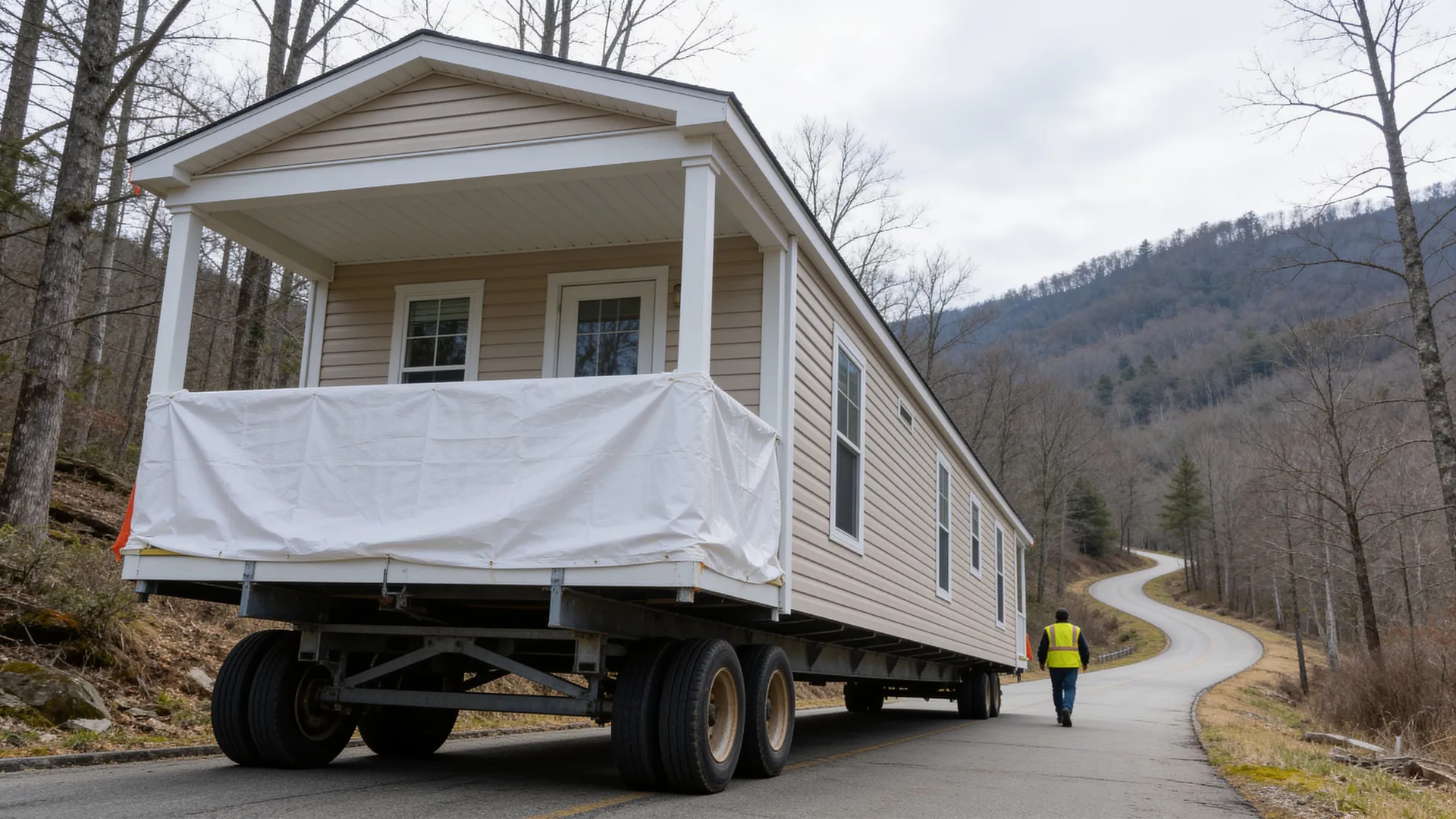
A manufactured home under tow on a North Carolina road under an NCDOT MH-2 oversize permit
Every legal North Carolina haul rides on an NCDOT MH-2 oversize permit plus a county tax-paid moving permit.

The set-up: licensing and NC OSFM inspection

North Carolina doesn't treat setting a home as casual labor. The installation — building the piers, blocking and leveling the chassis, and anchoring it — is regulated work that requires a state set-up / installation credential, and the finished set is inspected before the home can be occupied. The governing standards come from the NC Office of the State Fire Marshal manufactured-home program, which adopts the state's manufactured-home installation regulations covering pier spacing, leveling tolerance, and tie-down. Anchoring in particular has to match the home's HUD wind zone, so a coastal Zone II home near Wilmington carries a heavier tie-down spec than an inland Zone I home around Asheville or Charlotte. An unlicensed set that fails inspection can void the home's warranty and its insurance — the reason the cheap install is the expensive one. The set-and-level work itself is covered on our setup and leveling pages.

The title: real property vs. movable home

Many North Carolina manufactured homes have been detitled to the land — converted to real property once they were permanently set — and a home titled to the land can't simply be towed off. To move it, the title status has to be addressed through the county tax office: the home is treated as movable again for the haul, then re-sited and, if it's staying put, often re-detitled to the land at the destination. When the home is crossing into South Carolina, a second titling system enters the picture entirely — that scenario is its own animal, covered on our moving a mobile home across state lines guide.

The destination: zoning and age caps

The last rule is the one people forget until it's too late: a home can be perfectly legal to tow and still be barred from where it's going. Towing is state transport law; siting is local zoning, and North Carolina jurisdictions vary widely. Many counties and towns confine manufactured homes to certain districts and enforce an age cap — refusing to permit installation of a unit older than 10, 15, or 20 years, with pre-1976 homes commonly excluded outright, and the exact threshold varies county to county from Rutherford and Burke in the west to Brunswick on the coast. The UNC School of Government's manufactured housing and zoning summary explains how NC localities are allowed to regulate placement. Confirm the receiving county's and any park's rules before you pay for the move — the age question is unpacked on can you move a pre-1976 mobile home, and the rules in neighboring states are on our South Carolina, Georgia, and Tennessee mobile home moving laws pages.

Questions

North Carolina moving law — straight answers

What permits does North Carolina law require to move a mobile home?
North Carolina law requires two permits working together. The first is a state oversize trip permit issued under the NCDOT Publication MH-2 rules, which authorizes the over-width load to travel. The second is a county tax-paid moving permit required under NCGS Chapter 105, Article 18 (the moving-permit provision is § 105-316.1 through .6), which the county tax office issues only once the home's property taxes are confirmed paid. The licensed transporter pulls both. A homeowner technically can, but the two have to land on the same approved travel day, which is why it's a transporter's job.
When can a mobile home legally travel on NC roads?
Movement is restricted to sunrise-to-sunset hours in good weather under the NCDOT MH-2 framework. Wider loads carry a tighter window — a 16-foot-wide home is limited to a 9:00 AM–2:30 PM band Monday through Saturday, while 12- and 14-foot homes may run sunrise to sunset. Movement stops in unsafe weather — high wind especially, because a manufactured home is essentially a sail on wheels — and oversize travel is restricted around major holidays. The exact window and routing are set on the permit itself, sized to the load's width and the approved route around low bridges and tight clearances.
Do you need a license to set up a mobile home in North Carolina?
Yes. Setting and tying down a manufactured home in NC is regulated work — it requires a state manufactured-home set-up / installation credential, and the finished installation is inspected before the home can be occupied. The standards come from the NC Office of the State Fire Marshal manufactured-home program, which adopts the state installation regulations governing piers, blocking, leveling, and anchoring. That's why an unlicensed "two guys and a truck" set is a real risk: a non-compliant installation can fail inspection, void the home's warranty, and jeopardize insurance. Anchoring specifically must meet the home's HUD wind zone — detailed on our mobile home anchoring page.
Can a lender move a repossessed mobile home in NC without the owner's permit?
North Carolina law has a narrow path for it. Under the moving-permit framework in NCGS Chapter 105, Article 18, a lien-holder repossessing a manufactured home can obtain a limited moving permit — commonly cited as valid for about 7 days — even when the property taxes aren't current, so a lender or its agent can relocate collateral without the defaulting owner's cooperation. It's still a licensed-transporter task with documentation requirements, and whether the unit is road-worthy enough to permit is its own question, covered on can a mobile home be moved.
Does North Carolina limit where you can place a mobile home?
Not at the state moving-law level, but heavily at the local level — and this trips up more moves than the haul ever does. Towing a home is governed by transport law; siting it is governed by county and municipal zoning. Many NC jurisdictions restrict manufactured homes to certain districts and enforce an age cap, refusing to permit installation of a unit older than 10, 15, or 20 years, with pre-1976 homes commonly excluded outright. The UNC School of Government summarizes how NC zoning treats manufactured housing in its manufactured housing and zoning overview. Always confirm the destination's rules before paying for the move — see can you move a pre-1976 mobile home.
Keep reading

Permits, escorts & the other Carolina

County programs & age rules

NC county programs and pre-1976 rules

Get a quote

Tell us about your move. We price it.

Unit, route, and timeline — that's all we need. Permits, NCDOT-certified escorts, and on-site setup are included in the quote, and you'll hear back within 24 business hours. We never sell or share your info.

Or call 24/7 — (828) 501-2670

Quote in 24 hours

Goes straight to our crew. We don't sell or share leads.