
Local re-level · Pier & shim · 1/4-inch tolerance · NC & SC

Mobile Home Leveling Near Me

Door won't latch, drywall cracking at the corners, a soft spot in the floor, a splitting marriage line — the home has drifted off level, and it won't fix itself. We crawl the chassis, measure every pier, and bring the frame back to true across North Carolina and South Carolina.

Licensed & insured · NC & SCNCDOT-certified escorts24-hour written quoteOne crew, start to finishPermits pulled in every county Licensed & insured · NC & SCNCDOT-certified escorts24-hour written quoteOne crew, start to finishPermits pulled in every county

Get a free quote

Back within 24 hours — no obligation.

Goes straight to our crew. We never sell or share leads.

Quick answer
Who does mobile home leveling near me, and what does it involve?
Mobile Home Mover Pro provides mobile home leveling across North Carolina and South Carolina — we crawl the steel chassis, measure the deflection at every pier, lift and shim the frame back to roughly 1/4-inch tolerance, and re-seat sunk footings and separated marriage lines. You need it when doors stick, drywall cracks at the corners, floors feel soft, or a double-wide's center seam splits. Send us your county, unit type, and symptoms and we return a written leveling quote within 24 business hours.

If you're searching mobile home leveling near me, something in the home has already gone wrong — a door that scrapes and won't latch, a crack crawling out of a window corner, a spot in the hallway that gives underfoot. That's not cosmetic. A manufactured home doesn't sit on a slab; it rests on a grid of concrete piers stacked under its steel I-beam frame, and those piers sit on ground that moves. As the soil settles, swells, or erodes, individual piers go slack and the frame sags between them — and every symptom you're seeing is the chassis telling you it's no longer flat. Mobile Home Mover Pro provides mobile home leveling across North Carolina and South Carolina, whether we set the home originally or not, and we quote the fix in writing within 24 business hours.

The signs you need leveling — before you call

You don't need a level to know a home has drifted; you need to know what to look for. Inside, the tells are doors and windows that stick or won't latch, diagonal cracks at door and window corners, gaps opening where the ceiling meets the interior walls, and soft or bouncy floors. On a double-wide, watch the center of the home: a crack or ridge down the marriage line means the two halves have settled unevenly. Outside, buckling skirting and visibly leaning piers are the giveaways. A quick homeowner test: set a marble on the floor in a few rooms — if it consistently rolls to one wall, the frame is out. The reason to catch it early is money. An out-of-level home overloads its floor joists and chassis, and the damage compounds; a re-level at the sticking-door stage is a fraction of the cost of the floor and drywall repairs that come after.
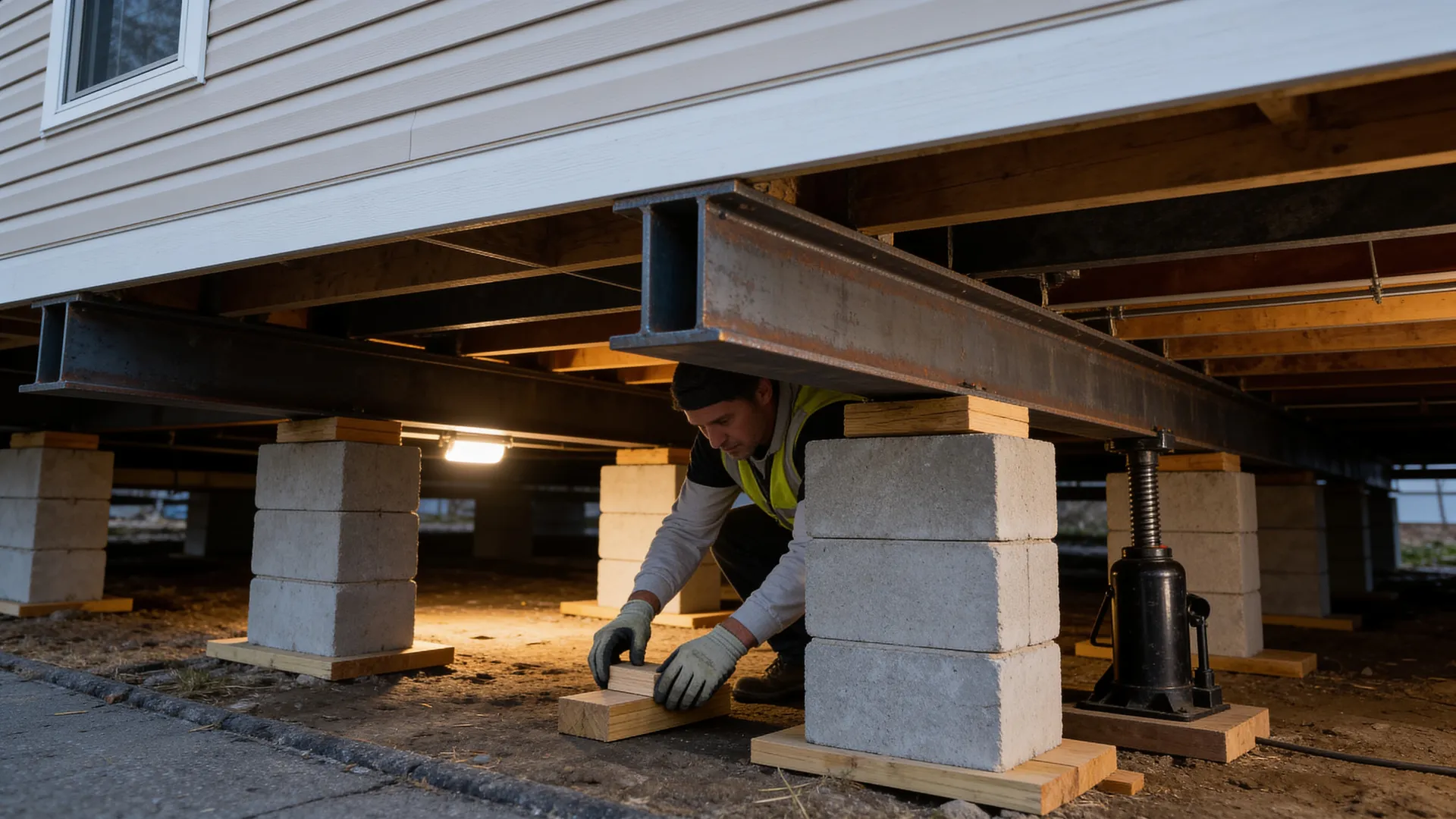
Local mobile home leveling — steel I-beam chassis shimmed back to true on concrete-block piers in NC
A re-level brings the steel chassis back to roughly 1/4-inch tolerance on its piers — the step that stops sticking doors and floor flex.

What a leveling visit actually involves

When our crew shows up, the work happens under the home, not in your living room. We run a level line the length of the steel I-beam chassis and find every pier that's lost firm contact with the beam. Then we lift the frame just enough with hydraulic jacks to re-seat each low point, take up the slack with hardwood or steel shims driven between the pier cap and the beam, rebuild piers that have crushed or tilted, and re-set sunk footings on a proper base. The target is the manufactured-housing installation standard of roughly 1/4-inch tolerance across the length of the chassis — the tolerance North Carolina's state manufactured-home installation regulations hold set-up crews to — flat enough that doors hang true and the floor stops flexing. A typical home rides on dozens of pier points, so it's methodical: measure, lift, shim, re-measure, move to the next. Leveling by feel instead of by measurement is exactly how homes end up "leveled" and still sticking a week later. While we're under there, we also eyeball the tie-down anchors, the vapor barrier, and the skirting attachment.

How leveling fits with setup, anchoring, and a move

Leveling is one of three distinct steps people lump together. A full mobile home setup is the entire installation when a home first lands on a new pad — building the piers, blocking, leveling, and tying down. Leveling is specifically the part that gets the frame flat and true, and it's the step that gets redone over the home's life as the ground moves. Anchoring is the separate tie-down system that holds the home against wind, governed by the federal manufactured-home construction and safety standard at 24 CFR Part 3280 and its anchoring subpart. The order matters — re-level first, then check the anchors, because tightening straps on a frame that's out of level just locks the distortion in. Leveling is also the far end of every relocation: a home is never truly "set" until it's leveled on the new pad, which is why it's a line item in any mobile home transport job. If you're hunting a whole crew rather than just a level, our mobile home movers near me page covers the full move.

Leveling across North Carolina and South Carolina

Where the home sits shapes how it drifts. In North Carolina, the heavy clay of the Piedmont and the WNC mountain coves swells when it's wet and shrinks when it's dry, working piers loose season after season, while the sandy coastal-plain counties east of I-95 shift and drain differently. Across the line in South Carolina, the Midlands and the Pee Dee bring their own mix of clay and sand. North Carolina enforces manufactured-home installation through the NC Office of State Fire Marshal's manufactured building program, and South Carolina licenses installers through the SC LLR Manufactured Housing Board — the same regulatory backbone that sits behind our transport and setup work, and the reason "who's licensed to do this" is a fair question to ask any crew. We level homes in both states, and you can see leveling work by county in Harnett County, NC, Gaston County, NC, and Spartanburg County, SC, among others.

Get a local leveling quote — the fast way

You don't have to have hired us for the move to have us level the home. A large share of our leveling calls are homes set years ago by someone else that have quietly drifted — park-lot homes, inherited homes, homes a previous owner never maintained. The fastest way onto the schedule is to send the details up front so we can size the job before rolling a truck: put the unit type, the symptoms you're seeing, and the county the home sits in on the form, and Mobile Home Mover Pro returns a written leveling quote inside 24 business hours. Door jammed shut, water pooling under the home, or an inspection bearing down on you? Flag it as urgent and we prioritize the routing.

Questions

Mobile home leveling near me — straight answers

Who does mobile home leveling near me in NC and SC?
We do. Mobile Home Mover Pro re-levels manufactured homes across North Carolina and South Carolina — from the Piedmont and the WNC coves to the coastal-plain counties and the SC Midlands. When you search "mobile home leveling near me," you're usually a homeowner with a door that won't latch or a crack you can't explain, and you want someone who'll actually crawl the chassis instead of eyeballing it from the yard. Give us the county the home sits in, the unit type, and the symptoms you're seeing, and we route a crew that works your area. We level homes we never moved as readily as ones we set — a large share of our leveling calls are homes another company installed years ago. Put your location on the form and we come back with a written number inside 24 business hours.
How much does mobile home leveling cost near me?
A standard re-level runs about $400–$1,200 for a single-wide and $700–$1,800 for a double-wide when the existing pier and blocking system is sound and only needs shimming back to spec. It climbs when piers have crushed or tilted, footings have sunk, or a double-wide's marriage line has separated and has to be re-mated — those land closer to $1,500–$3,500. Three things move the number: how many piers are off, whether the ground under them has to be re-compacted or re-footed, and how much room there is to work under the home. We won't quote a leveling job from the doorway — we crawl the chassis, measure the deflection at every pier, and put the exact pier count in writing. Where that fits inside a full relocation is mapped on our cost to move a mobile home breakdown.
What are the signs my mobile home needs leveling?
The home tells you before the frame does. The classic signs are doors and windows that stick or won't latch, cracks running diagonally out of door and window corners, gaps opening between the ceiling and the interior walls, soft or bouncy spots in the floor, and on a double-wide a ridge or crack down the marriage line where the two halves have drifted apart. Outside, look for skirting that's buckling or pulling loose and piers that visibly lean. If a marble rolls to one wall or you feel the floor tilt underfoot, it's already well out. Catching it at the sticking-door stage is far cheaper than waiting for the floor — an out-of-level home overloads the joists and chassis and the damage compounds.
How soon can you come level my mobile home?
Turnaround depends on where the home sits and how far off it is, but we move fast on leveling because it's usually a one-day job once we're on site. The written quote comes back within 24 business hours of your request; scheduling the crew after that is typically days, not weeks, for most NC and SC counties we cover. If a door has jammed shut, water is pooling under the home, or you've got a sale or refinance inspection bearing down, flag it as urgent on the form and we prioritize the routing. The fastest way to get on the schedule is to send the unit type, symptoms, and location up front so we can size the job before we roll a truck.
What happens during a mobile home leveling visit?
The crew goes under the home — this isn't a from-the-doorway job. First we run a level line down the length of the steel I-beam chassis and find every pier that's no longer in firm contact with the beam. Then we lift the frame just enough with hydraulic jacks to re-seat each low point, take up the slack with hardwood or steel shims between the pier cap and the beam, rebuild any piers that have crushed or tilted, and re-set footings that have sunk onto a proper base. We measure, lift, shim, and re-measure pier by pier until the chassis is back to roughly 1/4-inch tolerance across its length. While we're under there we also check the tie-down anchors, the vapor barrier, and the skirting attachment and flag anything that should be addressed. A typical home rides on dozens of pier points, so it's methodical work — but done right, the doors close and stay closed.
Do you level double-wides near me, or only single-wides?
Both. A double-wide re-level is more involved because the home is two separate halves bolted together down a center seam — the marriage line — and that's where an out-of-level double-wide shows itself first. When one half settles more than the other, the line opens up: a crack runs down the center of the ceiling, a ridge appears in the floor, or you see daylight at the ridge beam. Leveling a double-wide means bringing both halves back to the same plane and re-seating the marriage-line connection, which takes more pier points and more measuring than a single-wide, and it's why it costs more. Triple-wides and on-frame modular homes carry the same logic across more seams. If a center ceiling crack keeps coming back after you patch it, the marriage line is drifting and the home needs a proper re-level — not more drywall mud.
Is mobile home leveling the same as setup or anchoring?
No — they're three separate steps that get blurred together. Mobile home setup is the whole installation when a home first lands on a pad: building the pier system, blocking the chassis, leveling it, and tying it down. Leveling (and re-leveling) is specifically the part that gets the steel frame flat and true, and it's the step that gets redone over the home's life as the ground moves under it. Anchoring is the tie-down system — augers and straps that hold the home against wind, governed by the federal manufactured-home standard at 24 CFR 3280 Subpart G. You re-level first, then check the anchors, because tightening straps on a frame that's out of level just locks the distortion in. Full installation detail lives on our manufactured home installation page.
How often should a mobile home be re-leveled?
Most manufactured homes need a re-level every 3 to 7 years, but the real driver is soil, not the calendar. A home on stable, well-compacted ground can hold its level for a decade; one on clay that swells and shrinks, on fill dirt, or in a spot with poor drainage can drift out within a year or two. Newly set homes settle the most in their first 12–18 months as the ground under the new piers compacts, which is why a check at the one-year mark is smart. The federal HUD Code that governs how these homes are built and installed — 24 CFR Part 3280 — sets the manufactured-housing construction standard, and North Carolina enforces installation through the NC Office of State Fire Marshal. After any drought-and-flood cycle, nearby excavation, or storm, it's worth a look.
Keep reading

Level it, set it, lock it down

By county

Mobile home leveling near you — by county

Not your county? We level across all of North Carolina and South Carolina — put your location on the form and we'll confirm coverage with your quote.

Get a quote

Tell us about your move. We price it.

Unit, route, and timeline — that's all we need. Permits, NCDOT-certified escorts, and on-site setup are included in the quote, and you'll hear back within 24 business hours. We never sell or share your info.

Or call 24/7 — (828) 501-2670

Quote in 24 hours

Goes straight to our crew. We don't sell or share leads.