
Moving a mobile home from Raleigh to Wilmington is one of the most common manufactured-home corridors in eastern North Carolina, and it's a clean one to run: a single state, a single interstate, and a single permit regime. People make this move constantly — a family leaving the Triangle for the Cape Fear coast, a home bought near Raleigh headed for a parcel in New Hanover or Pender County, a dealer-sold unit going from a Wake County lot to a beach-town community. Because both ends sit inside North Carolina, you avoid the second-state titling and dual-permit chain that makes a cross-state move so heavy. What you trade for that simplicity is a genuine anchoring change at the destination, and that's the part most people don't plan for. Mobile Home Mover Pro runs this corridor end to end — permits, escorts, haul, and coastal setup — with one crew owning the whole chain.
The route: I-40 East, Raleigh to the coast
The haul is almost entirely Interstate 40 East. I-40 leaves the Raleigh / Wake County area and runs southeast through Johnston, Sampson, Duplin, and Pender counties, passing the Benson, Newton Grove, and Warsaw interchanges before dropping into New Hanover County and terminating in Wilmington. It's roughly 130 miles and a 2 to 2.5-hour drive at legal load speed — longer in practice, because an oversize manufactured home only moves inside the legal daylight window. I-40 is the right spine for this load: it's controlled-access the whole way, with wide lanes and full shoulders that a 14- to 16-foot-wide home needs, and almost no urban bottleneck between the two metros. The terrain is forgiving too — this is flat to gently rolling coastal-plain country, no mountain grades to fight, which keeps the haul predictable. Homes coming off back-lots near US-70, US-117, or NC-50 get a short local leg over those state routes onto I-40, and we pre-drive any low overpass or tight on-ramp before move day so nothing surprises the load.
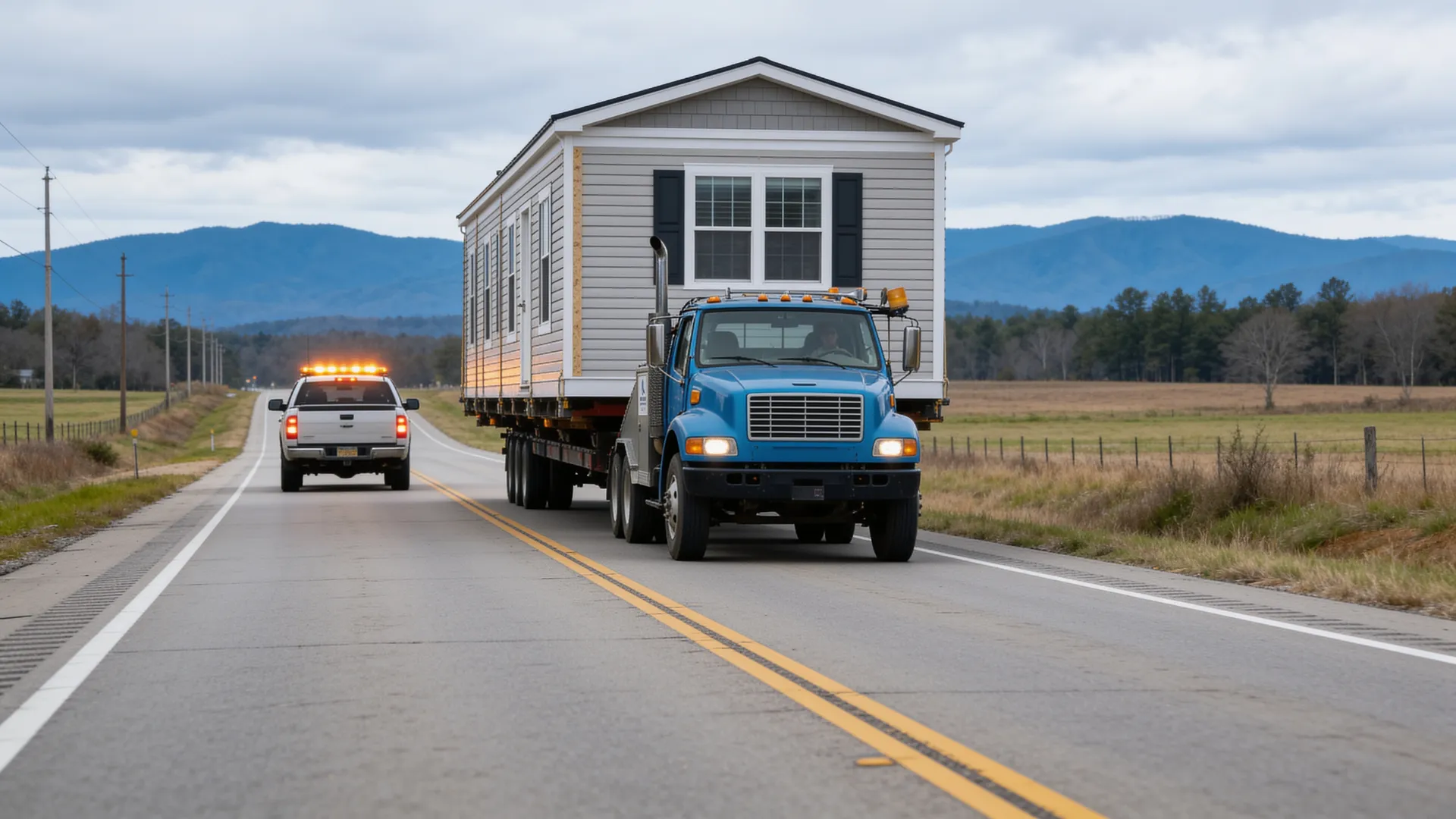
One permit regime — but two county tax gates
Because this move stays inside North Carolina, you deal with a single permit framework rather than the stacked dual-state chain a coastal NC↔SC haul demands. That framework still has two distinct permits. The first is the NCDOT oversize trip permit issued under NCDOT Publication MH-2, which sets the approved I-40 routing, the daylight-only travel window, the 25-mph wind cutoff that grounds the load, the low-bridge avoidance, and the escort count that scales with the home's width. The second is the county tax-paid moving permit required by NCGS Chapter 105, Article 18 (§ 105-316.1) — the origin county tax office won't release the home until its personal-property taxes are current. The practical wrinkle on a corridor move is that two counties are in the picture: the origin county that clears the home to leave, and New Hanover County at the destination. A back-tax balance on the origin side freezes the move until it's settled, so we start the tax-clearance step the day the move is booked. The county-by-county mechanics live on our North Carolina mobile home moving laws guide, and the UNC School of Government's Coates' Canons explainer lays out the statutory basis for the permit itself.
Escorts and the daylight window
An over-width manufactured home doesn't travel alone on I-40. Under the MH-2 framework, North Carolina requires NCDOT-certified Escort Vehicle Operators, with the number of front and rear escorts scaling up as the load gets wider — a standard single-wide may need fewer than a 16-foot-wide double-wide section. The same rules confine movement to a legal daylight window and shut the move down when wind gusts top 25 mph, which on the open coastal-plain stretch of I-40 between Newton Grove and Wilmington is a real consideration in a stiff spring or storm-season breeze. We book the escorts to the load's certified width, time the run inside the window, and hold the home rather than push it into marginal wind. The full state escort thresholds are detailed on our mobile home transport escort requirements page.
The real shift: inland anchoring to coastal Wind Zone II
This is the part of a Raleigh-to-Wilmington move that catches people off guard. Raleigh and most of the Piedmont sit in HUD Wind Zone I (≈70 mph design wind), but Wilmington and the entire Cape Fear coast fall in Wind Zone II (≈100 mph). The federal anchoring rules in HUD 24 CFR Part 3280, Subpart G require the home to be tied down to the wind zone where it sits, which means a home that left Raleigh on a Zone I spec has to be re-anchored to Zone II when it lands near the coast — more auger ground anchors, both frame-tie and over-the-top straps, and tighter spacing. After Hurricane Florence flooded the Cape Fear basin in 2018, coastal anchoring isn't a formality; it's the difference between a home that rides out a storm and one that doesn't. We set every Wilmington-area home to Zone II and document the anchoring for your insurer. The destination-specific setup detail lives on our Wilmington mobile home movers page.
One crew, pad to pad
Stack it up — the I-40 route, the MH-2 permit, dual-county tax clearance, certified escorts, the daylight window, and the inland-to-coastal anchoring change — and a Raleigh-to-Wilmington move is straightforward only when one crew owns all of it. That's how we run it: we pull the NCDOT trip permit and the origin-county tax permit, book the escorts to the load's width, haul the home down I-40 inside the legal window, set it on the new pad, level the chassis to a 1/4-inch tolerance, and re-anchor to coastal Wind Zone II before we leave. No handoffs, no half-permitted seam in the middle. Put your origin, destination, and unit type on the form and we'll price the full pad-to-pad move — permits, escorts, haul, and setup — within 24 business hours. If you're weighing the bigger picture first, start with our mobile home transport overview or moving a mobile home across state lines for the cross-state comparison.