
Moving a mobile home from Greenville to Columbia is one of the most common in-state hauls in South Carolina — a straight Upstate-to-Midlands run that families, dealers, and investors make constantly. A single-wide leaves a Greenville County park for land near Lexington; a double-wide bought in the Upstate heads for a lot in the Columbia area. Because both ends sit inside South Carolina, this move avoids the hardest part of a cross-state haul: there's only one state regulatory regime, not two. But "in-state" is not the same as "simple" — the corridor still crosses several counties, the moving permit still rides on a treasurer's tax-clearance, and an oversize load still needs trip permits and escorts. Mobile Home Mover Pro is a licensed mobile home mover that owns the whole job, so your Greenville-to-Columbia move never gets split across separate outfits.
The route: I-385 down to I-26
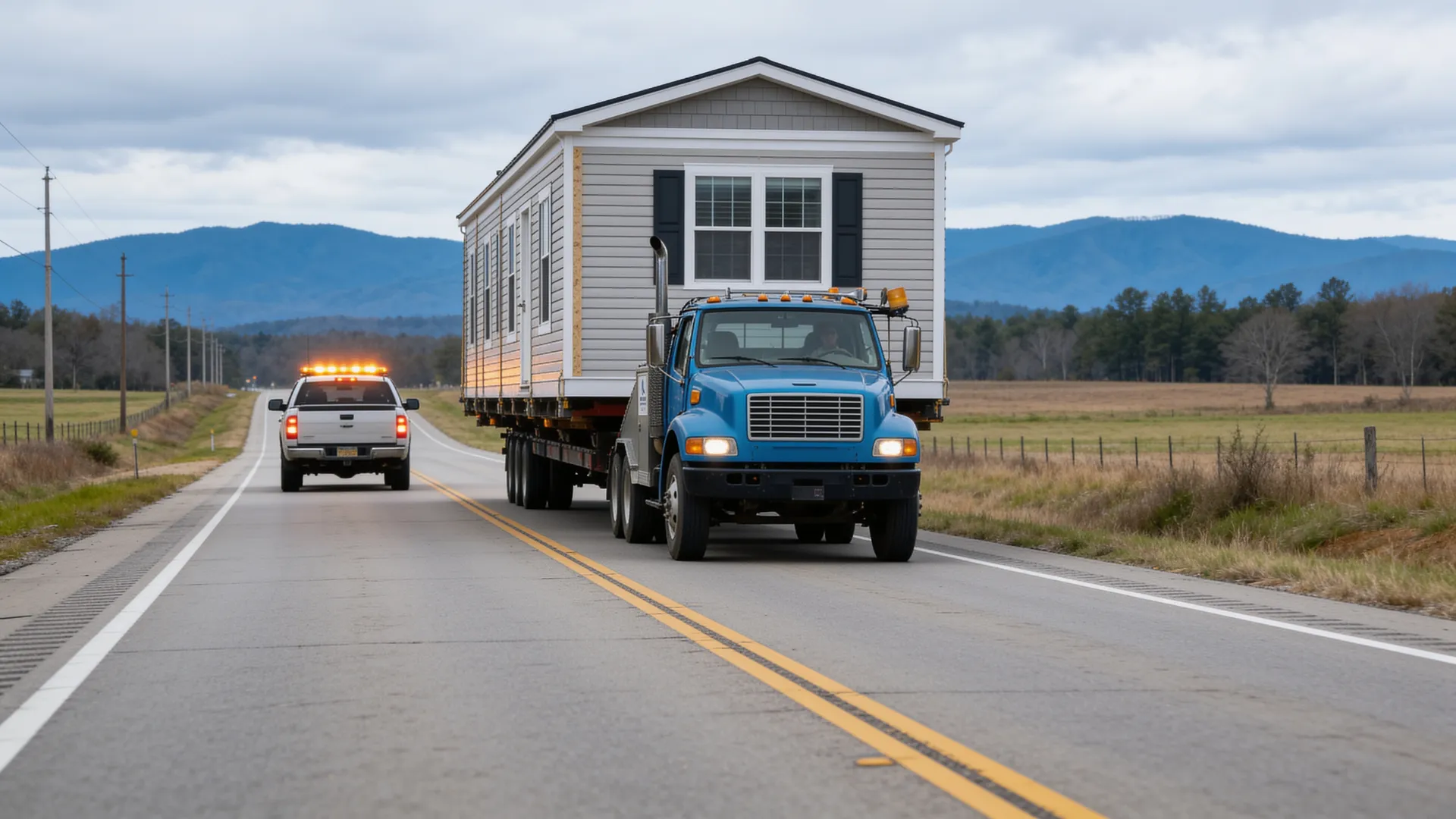
The Greenville-to-Columbia corridor is one of the cleaner runs we make. The haul leaves Greenville on Interstate 385 heading southeast through Mauldin, Simpsonville, and Fountain Inn, then carries down past Clinton and Laurens to where I-385 ties into Interstate 26 East. From that junction I-26 is the spine the rest of the way — through Newberry County and across the Midlands — until it reaches the Columbia interchange complex where I-26 meets I-126, I-20, and I-77. Straight-line it's roughly 100 to 105 miles and about a 1-hour-40-minute drive in a passenger car, but a permitted oversize manufactured home moves slower and only inside the legal daylight travel window, so we plan it as a focused single-day haul with the route pre-cleared. The terrain works in our favor: this is gentle Piedmont rolling into the Sandhills, with no mountain grades or coastal exposure to fight. The real routing work is the engineered detail — overhead clearance for a 13- to 14-foot-tall load, low-bridge avoidance, and a clean path through the busy Columbia interchange — all settled before travel day, not improvised on the shoulder. The state rules that govern that routing are broken out on our South Carolina mobile home moving laws guide.
One state, two counties, one permit chain
The thing that makes a Greenville-to-Columbia move simpler than a cross-state haul is that it answers to a single regulatory regime. South Carolina issues the moving permit under SC Code § 31-17-360 through the destination county's licensing agent, and that statute won't let the permit issue until the county treasurer certifies the home's taxes are paid and the utilities are disconnected. That's the gate that catches owners off guard: it isn't the haul that stalls a move, it's an unpaid balance on the tax roll. And because the home is leaving Greenville County and arriving in the Columbia-area destination county, both counties' tax statuses have to be clean — two treasurer offices, one statute. On top of the § 31-17-360 moving permit, an over-width load needs an SCDOT oversize trip permit that sets the legal daylight window, the wind cutoff, the routing, and the escort count. We file the permit chain and clear both counties before travel day, so nothing about the legal status of the move is left to discover the morning of the haul. The full statute, decal, and clearance detail lives on our SC moving laws and mobile home moving permit pages.
Titling: severance before the home can travel
Permits get the home down the interstate; titling decides whether it can legally move at all. Most settled manufactured homes around Greenville have been detitled to the land — converted to real property — and a home titled to the land can't just be towed away. It has to be severed back to a movable title first, traveled, and then re-sited (and often re-detitled to the land) once it reaches the Columbia area. South Carolina handles severance, the moving-permit decal, and the title action through § 31-17-360 and the SCDMV. The procedural detail — affidavits, forms, and which office signs off — is documented by the Manufactured Housing Institute of South Carolina. Even on an in-state move this is the step that most often stalls a purchase or refinance, so we start the title chain the day the move is booked, not the week of the haul.
Escorts and the oversize load
An over-width manufactured home doesn't travel I-385 and I-26 alone — it travels under escort. South Carolina sets its own escort requirements, with the number of escort vehicles scaling with the load's width, and for the widest loads the state can require a law-enforcement escort rather than a civilian one. Because this corridor threads the busy Columbia interchange where I-26, I-126, I-20, and I-77 converge, the escort plan and the routing have to account for the tightest point on the whole run before travel day. We size the escorts to the actual unit and pre-clear the route, so the load and its escorts hit the Midlands interchange with a plan, not a guess. The escort thresholds are detailed on our mobile home transport escort requirements page.
Why one crew owns the whole corridor
Stack it up — the § 31-17-360 moving permit, tax-clearance in two county treasurer offices, an SCDOT oversize trip permit, severance and titling, and escorts through the Columbia interchange — and the single point of failure on a Greenville-to-Columbia move is the handoff: the seam where the haul company, the permit filer, and the setup crew each own only a slice of the job. A crew that owns the whole corridor erases that seam. We clear Greenville County's tax status, file the destination county's § 31-17-360 permit and treasurer certificate, pull the SCDOT trip permit, handle the severance and title action, book escorts to the load's width, and run the home down I-385 to I-26 with one chain of custody from the old pad to the new one. Put your origin, destination, and unit type on the form and we'll price the whole pad-to-pad move, permits included, within 24 business hours. If you're not sure your specific unit can make the haul, start with can a mobile home be moved, then see how this corridor fits into our broader mobile home transport service.