
Moving a mobile home from Greenville to Charleston is one of the longest in-state hauls in South Carolina — corner to corner, Upstate to coast — and it's a move that rewards a carrier who knows the whole length of I-26, not just one end of it. The two metros anchor opposite ends of the state: Greenville the Upstate manufacturing and dealer hub, Charleston the booming Lowcountry coast. Homes run this corridor constantly — a single-wide bought off an Upstate dealer lot headed for a Lowcountry parcel, a double-wide following a family relocation to a Charleston-area job, an investor moving a unit from a Greenville County park to land in Berkeley or Dorchester. Unlike a cross-state move, this one stays inside South Carolina, so there's a single permit regime and a single titling office system — but at roughly 200 miles, the distance and the coastal destination do the work that a state line does on other routes. Mobile Home Mover Pro runs it ourselves, start to finish, with no handoff in the Midlands.
The route: I-385 to I-26 East, Upstate to the coast
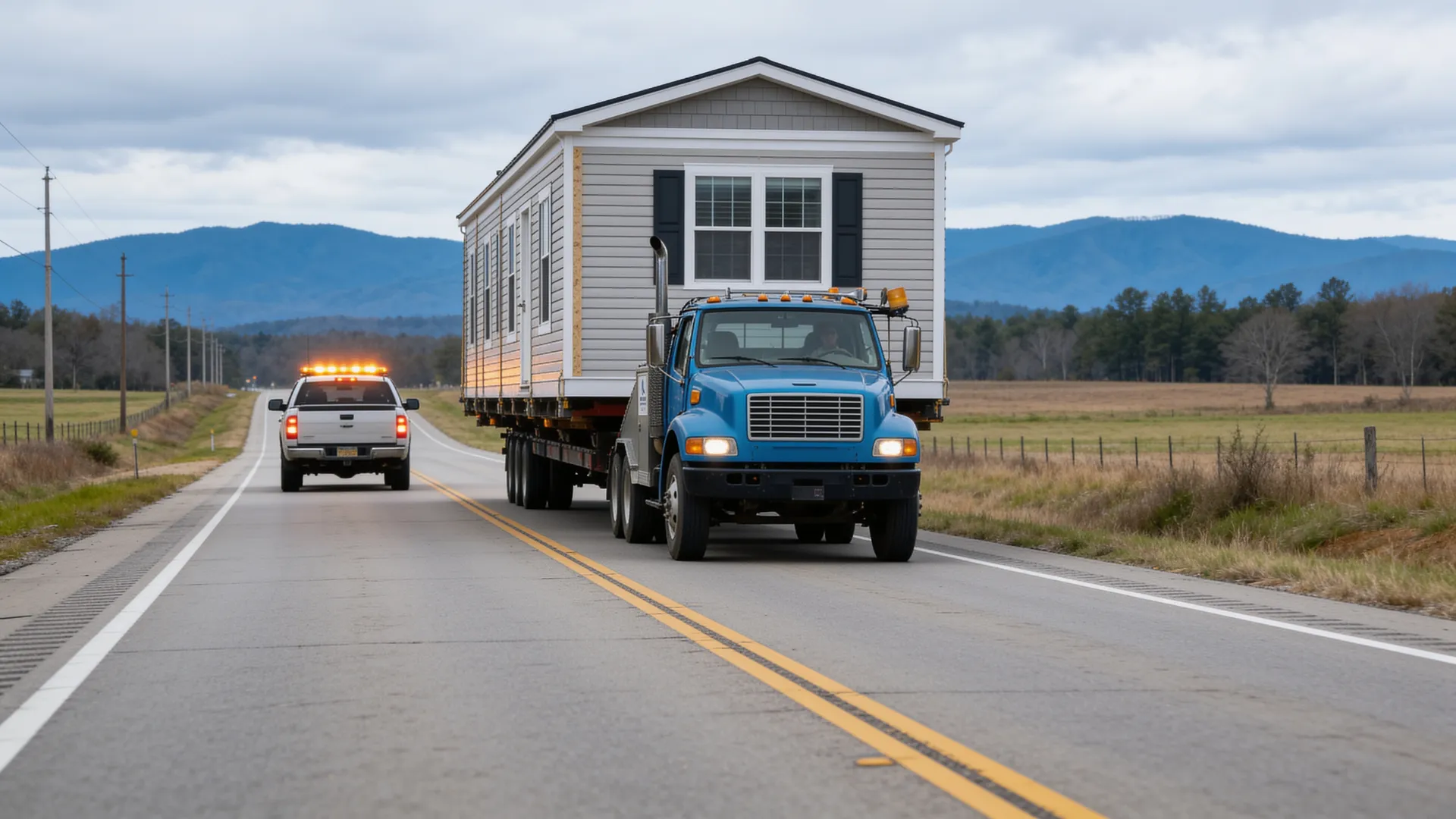
The corridor is long but mostly straightforward interstate until the very end. The direct line is I-385 South out of Greenville down to I-26, then I-26 East the full way to Charleston — roughly 200 miles, about a 3-hour drive in a car, which on permit for an over-width home becomes a planned full-day haul inside a legal daylight window, sometimes with an overnight stage. The run changes terrain three times: the rolling Upstate Piedmont out of Greenville and past Spartanburg, the flattening Midlands through Newberry and around Columbia, then the dead-flat Lowcountry coastal plain from the Orangeburg stretch down toward the Charleston tri-county. The open miles aren't the problem — the Lowcountry approach is. The Charleston metro runs on older bridges and marsh causeways, lower secondary-road overpasses, heavy live-oak canopy, and tighter park and lot access than anything in the Upstate. An over-width section that rolls easily on I-26 can hit a clearance or turn-radius wall in the last ten miles, so we pre-route every section around low overpasses, weight-restricted structures, tree canopy, and tight ramps before the truck rolls. The route is engineered, not improvised.
One state, one permit regime — but a full oversize chain
The advantage of a Greenville-to-Charleston move over a cross-state haul is that you stay inside South Carolina, so you're under one permitting and titling system instead of stacking two. That doesn't make it a short job — a 200-mile over-width run still needs the complete oversize chain. We pull an SC oversize/overwidth trip permit that sets the legal daylight travel window, the wind cutoff, the low-bridge routing, and the escort count for the load. The county licensing agent issues the moving permit under SC Code § 31-17-360, and that statute is explicit that the permit can't issue until the county treasurer certifies the home's taxes are paid and the utilities are disconnected. The full statutory framework lives in SC Code Title 31, Chapter 17, and the whole origin-and-destination rule set is broken out on our South Carolina mobile home moving laws guide and the mobile home moving permit page.
The dual-county tax and clearance gate
Even on an in-state move, a cross-county haul like this touches two county tax offices, and that's where most Greenville-to-Charleston moves get hung up. The tax-paid certificate that unlocks the § 31-17-360 permit is pulled against the origin record in Greenville County — if there's a back-tax balance on the home there, the move freezes until it's settled, no matter how ready everything else is. At the destination end the home is re-sited and decaled under the rules of whichever Charleston-area county it lands in — Charleston, Berkeley, or Dorchester — each with its own licensing agent and treasurer counter. South Carolina's titling, severance, and decal mechanics are documented by the Manufactured Housing Institute of South Carolina and run through the SC DMV. If the home had been detitled to the land at the Greenville address, it has to be severed back to a movable title before it can legally travel, then re-sited at the Charleston site. We run the Greenville County tax check and the destination-county requirements up front, the day the move is booked, so a closing, refinance, or park move-in never stalls on a county counter.
Escorts and the Lowcountry clearance challenge
South Carolina requires escort vehicles for an over-width manufactured home, with the number of front and rear escorts scaling with the load's width — and for the widest loads, the state can require a law-enforcement escort rather than a civilian pilot car. On the Greenville-to-Charleston run the escort plan earns its keep at the bottom of the route, not the top: the open interstate through the Midlands is routine, but the Charleston approach — narrow causeways, older bridges, canopy roads, and tight final-mile park access — is where escorts and a brake-and-clearance plan matter most. We arrange the escort to satisfy the load's width across the whole trip and tighten the spacing and routing for the Lowcountry leg, because one crew is coordinating the highway and the final mile as a single plan. The width thresholds and escort detail sit on our mobile home transport escort requirements page, and the haul mechanics on our mobile home transport overview.
What it costs, and where the long-haul premium lands
The haul is priced on distance and sections: roughly $3,000–$8,000 for a single-wide and $7,000–$15,000 for a double-wide in this regional range. At about 200 miles, Greenville-to-Charleston sits toward the upper end of those bands — but the premium here is distance, not a second state. There's no dual-state permit set; the cost driver is the length of the run (fuel, escort hours, a possible overnight stage) plus the Lowcountry routing, where tight clearances and Charleston-metro bridges can add escort and pilot-car time. The biggest single swing, as on any SC move, is the treasurer tax-clearance gate — a back-tax balance in Greenville County halts the move until it's cleared — which is why we check it before anything else is scheduled. The full breakdown is on our cost to move a mobile home guide.
Why one crew running the whole route is the answer
Stack it up — a 200-mile oversize permit, the § 31-17-360 moving permit, a dual-county tax-clearance gate, escort coordination that has to hold from the Upstate interstate to a tight Lowcountry park, and a destination county (Charleston, Berkeley, or Dorchester) to re-site and decal in — and the single point of failure on a long in-state move is a carrier that knows the highway but not the coast, or quits the job partway down. Mobile Home Mover Pro runs the whole length ourselves. Our crew pulls the SC oversize trip permit, clears the § 31-17-360 moving permit against the Greenville County tax record, handles any severance and the destination-county decal, books the escort to the load's width with the Charleston approach planned in, and keeps one chain of custody from the Greenville pad to the new Lowcountry site. That's the difference between a move that arrives on schedule and one that gets stuck ten miles from the lot. Put your origin, destination, and unit type on the form and we'll price the whole haul, permits included, within 24 business hours. Setting up on the Upstate end of this route? Our Greenville mobile home movers page covers the local origin side, and moving a mobile home across state lines covers the full NC↔SC framework if your move crosses the border instead.