
Moving a mobile home from Charlotte to Asheville is one of the most common manufactured-home runs in western North Carolina — and one of the more demanding, because it trades flat Piedmont mileage for a sustained climb over the Blue Ridge. Families leave the Charlotte metro for cheaper mountain land, a home gets bought off a Mecklenburg County lot for a parcel near Asheville, an investor relocates a single-wide from Gastonia up to Buncombe County. The mileage is modest — roughly 120 to 135 miles depending on route — but every mile past Marion is mountain. Because both cities sit inside North Carolina, this is a single permit regime, which is genuinely simpler than a cross-state move. Mobile Home Mover Pro is a licensed mover that runs this corridor under one crew, start to finish.
The real route: I-40 over the Old Fort grade, or US-74 through the foothills
There are two legitimate corridors between Charlotte and Asheville, and we choose based on unit width and live clearance data rather than the shortest map line. The classic mountain route is I-40 West — Charlotte out through Hickory, Morganton, and Marion, then up the Old Fort grade, a steep, curving climb over the Eastern Continental Divide that crests near Ridgecrest and Black Mountain before dropping into the Asheville basin. The alternative is the I-85 South to US-74 West line through Gastonia, Shelby, Rutherfordton, and Lake Lure country, joining the mountains from the south. Charlotte sits around 750 feet of elevation; Asheville sits above 2,100 feet, and that 1,350-foot gain is the entire story of this haul. Under normal traffic either route is about 2 to 2.5 hours, but a permitted oversize load travels slower, in daylight, and only inside the approved window. We drive the chosen route ahead of the move to confirm bridge heights, the 14-ft-tall load clearances, and switchback radius before a wheel turns.
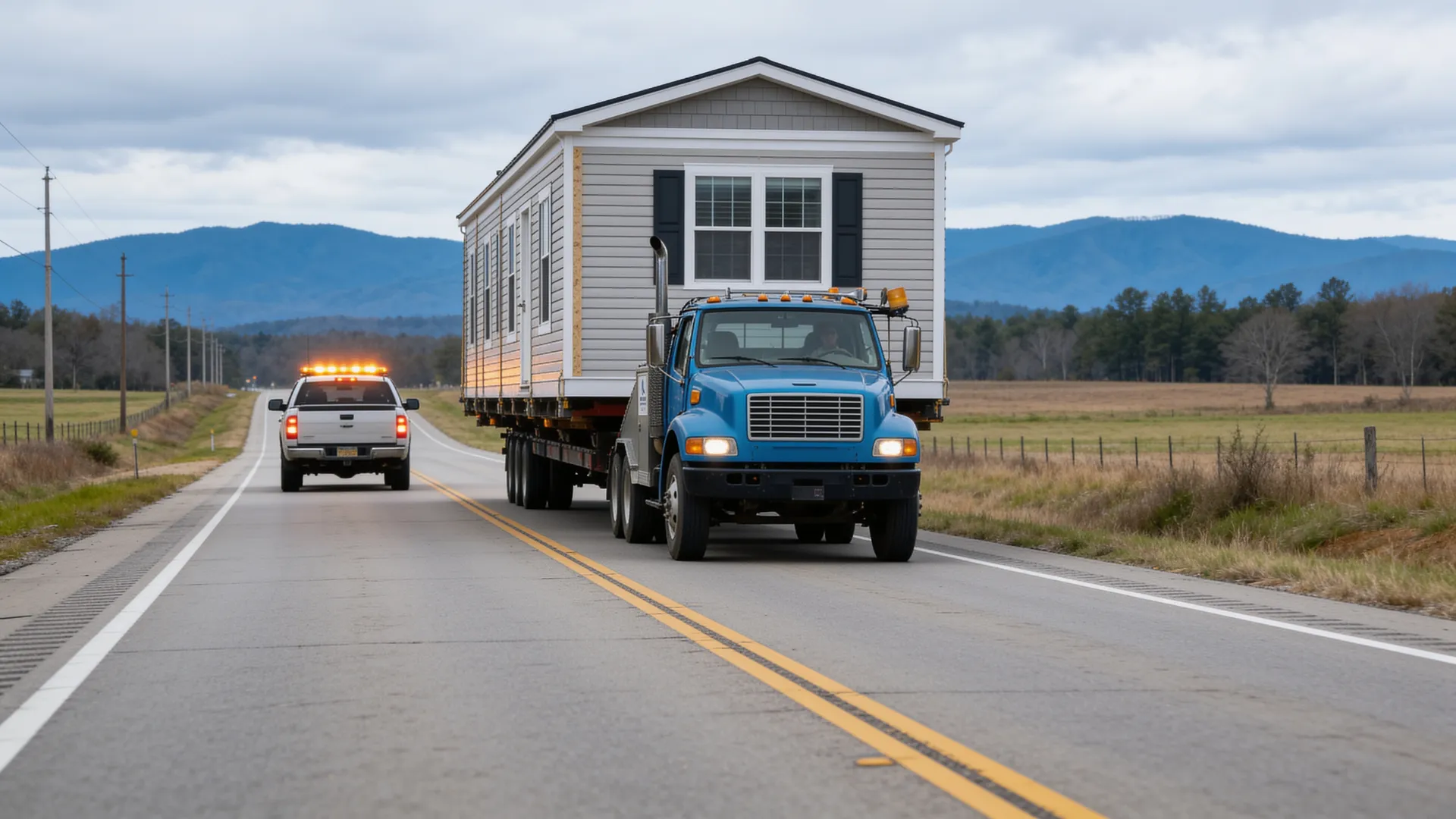
One permit regime — but two county tax gates
The good news on an intra-NC move is that you clear one state permitting system, not two. The home needs an NCDOT oversize/overweight trip permit issued under the NCDOT Publication MH-2 mobile/modular home rules, which fix the daylight travel window, the 25-mph wind cutoff, the routing around low bridges, and the number of front and rear escorts that scale with the load's width. What people miss is that the county tax-clearance step still runs twice: under NCGS Chapter 105, Article 18 the home can't get its moving permit until Mecklenburg County certifies property taxes are current at the origin, and Buncombe County recognizes the same clearance when the home is sited at the destination. A back-tax balance in either county freezes the move until it's settled — which is exactly why the title and tax steps are started the day the job is booked, not the week of the haul. The county-level mechanics are documented on our mobile home moving permit guide and the full state framework on our North Carolina mobile home moving laws page.
Grade, clearance, and escorts on the mountain leg
The Charlotte-to-Asheville corridor is harder than a flat haul of equal mileage for two reasons: grade and clearance. On the Old Fort approach, I-40 climbs roughly 1,000 feet in a short, curving span, which demands a heavier toter, disciplined brake and grade management on the descent into the basin, and extra escort coverage on the slow uphill segments. The mountain stretches also carry tighter shoulders, older bridges, and overhead pinch-points that a 14-ft-tall load has to be routed around — the reason we confirm clearances on the ground rather than trusting a map. NCDOT requires certified Escort Vehicle Operators with the front/rear count scaling to width under the MH-2 framework, and it bars oversize travel entirely in winds above 25 mph or outside daylight off-peak windows, which matters on exposed ridge stretches near the Continental Divide. We build those travel windows into the schedule up front so your move isn't sitting on a weather hold halfway up the mountain. The full escort thresholds are on our mobile home transport overview.
Single-wide vs. double-wide on this corridor
A single-wide moves in one section and clears the corridor most cleanly; budget the $3,000–$8,000 band, with the mountain climb pulling most Charlotte-to-Asheville quotes toward the upper half. A double-wide travels as two sections and runs $7,000–$15,000, because each section is permitted, escorted, and hauled, then re-married at the destination. On this route the limiting factor is rarely the interstate miles — it's the destination access road in the coves and hollows around Asheville, where steep gravel drives, switchbacks, and low utility lines often force a winch-assist or a transfer to a shorter-wheelbase toter for the final pull onto the pad. The price is driven by distance, section count, and escort hours more than anything else, and the cross-region climb is what separates this corridor's pricing from a same-mileage Piedmont move.
Why one crew, door to door, is the whole answer
Even on a single-state move, the failure point is a handoff — a mover who pulls the permit but subs out the escorts, or hauls the home but leaves the setup to someone else. On a Charlotte-to-Asheville run that seam is dangerous, because the mountain leg punishes any gap in coordination. Mobile Home Mover Pro pulls the NCDOT MH-2 trip permit, clears the Mecklenburg and Buncombe tax offices, dispatches certified escorts to the route's width and grade, drives the haul over the Blue Ridge, and sets, levels, and anchors the home on the new pad — one chain of custody from the old lot to the new one. If you're moving the other direction, or to a nearby mountain town, our Asheville mobile home movers page covers Buncombe County in detail. Put your origin, destination, and unit type on the form and we'll price the whole Charlotte-to-Asheville move — permits and escorts included — within 24 business hours.