
Mobile home leveling cost is the number people most want off a single phone call, and it's the one an honest crew can't give you sight-unseen — because the price isn't set by the size of the home, it's set by what the dirt underneath it has done. A manufactured home rests on a grid of piers stacked under its steel I-beam frame, and those piers sit on ground that settles, swells, and erodes. When individual piers go slack, the frame sags and the repair bill tracks how many piers are off and how far, not the home's floor area. Mobile Home Mover Pro re-levels homes across North Carolina and South Carolina — whether we set the home originally or not — and the number below is always built from a real measurement, not a guess.
The four factors that set your leveling price
Every leveling quote we write comes down to the same four levers, and understanding them tells you where your job lands before we ever get under the home.
1. Pier count — how many are off. A typical home rides on dozens of pier points. If three or four have gone slack, that's a light job; if a third of them have dropped, it's a big one. Pier count is the single biggest driver of mobile home leveling cost, which is why we measure deflection at every pier rather than eyeballing the low corner.
2. Single-wide versus double-wide. A single-wide is one structure on one pier grid. A double-wide is two independent halves bolted down a center marriage line, and leveling it means bringing both halves to the same plane and re-seating that seam — more pier points, more measuring, more labor. That's why a double-wide costs more than a single-wide of the same footprint, and why triple-wides and on-frame modulars cost more again.
3. Crawl-space access. Leveling happens from under the home. A home set high on open piers is fast to work; a low chassis over wet clay, packed with ductwork, or sealed behind tight skirting that has to come off first, is slow — and labor is the biggest line on the invoice. Access is the factor people forget, and it can swing the price on two otherwise-identical homes.
4. Shim-only re-level versus full re-block. If the piers are sound and just need snugging, we drive shims and re-measure — the cheapest version of the job. If piers have tilted, cracked, or crushed and footings have sunk, they get rebuilt and re-set, which is a full re-block and costs more. Most homes need the shim job; the re-block is what you're avoiding by catching settling early.
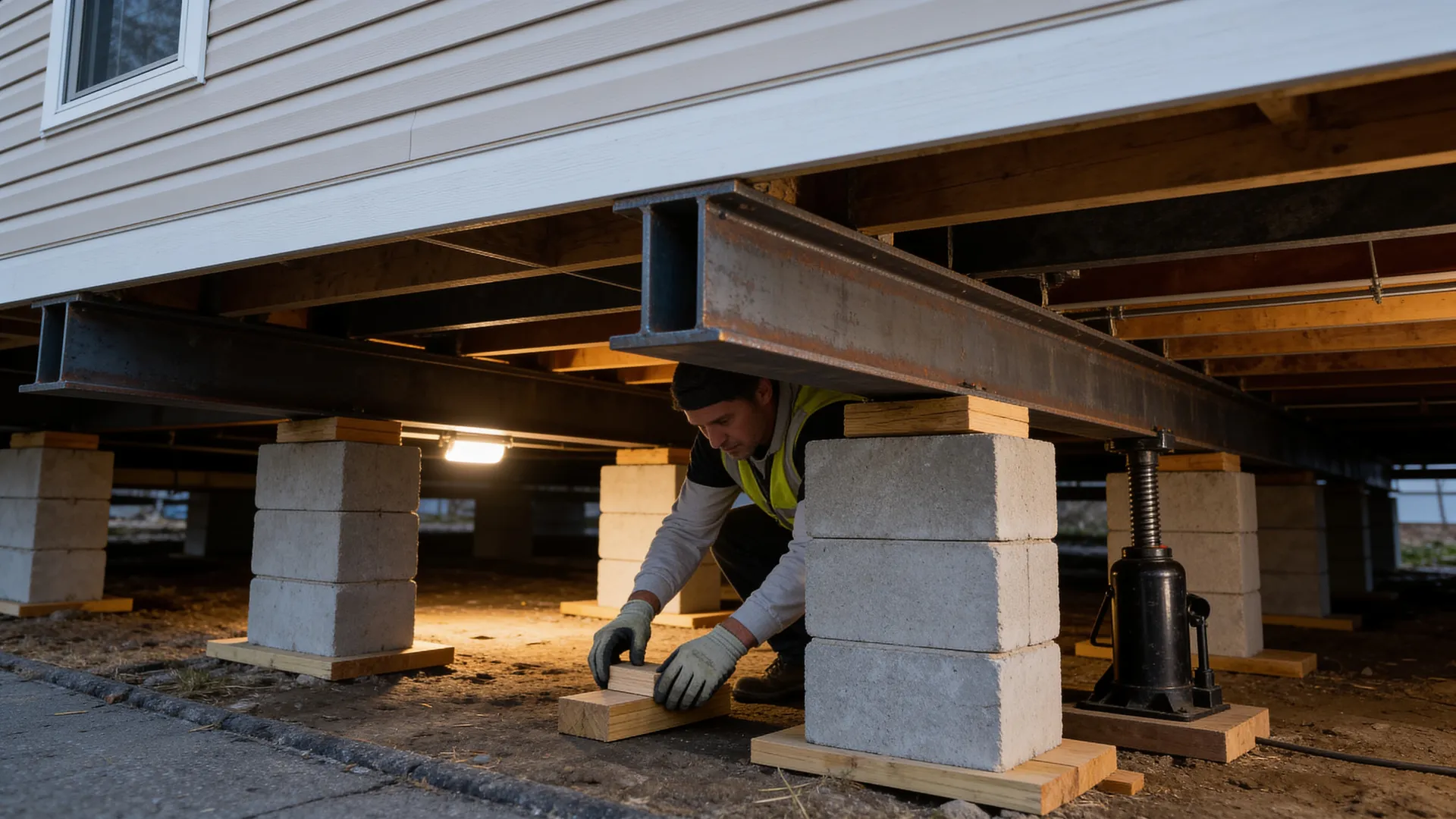
Shim vs re-block — what you're actually paying for
The difference between a cheap re-level and an expensive one comes down to whether the piers survive. In a shim-only re-level, the crew goes under with hydraulic jacks and a level line, finds every pier that's no longer in firm contact with the beam, lifts the frame just enough to re-seat it, and takes up the slack with hardwood or steel shims between the pier cap and the I-beam. Nothing comes apart. In a full re-block, piers that have tilted or crushed are torn down and rebuilt, and footings that have sunk into soft ground are re-set on a proper base before the frame goes back down. The target for both is roughly 1/4-inch tolerance across the length of the chassis — flat enough that doors hang true and the floor stops flexing. Paying for the standard is the point; a home "leveled" by feel instead of by measurement is the one that starts sticking again a week later.
Why the dirt — not the home — writes the invoice
The home was level the day it was set. What changes is the ground. Under every pier is a footing, and under every footing is soil with its own behavior: the sandy coastal plain drains and shifts, the heavy clay of the Piedmont and the WNC coves swells when wet and shrinks when dry, and fill dirt keeps compacting for years. Drainage makes it worse fast — a downspout dumping beside the chassis or a pad that sheds water underneath will undermine piers in a single wet season. A new home settles most in its first 12 to 18 months, which is why a one-year level check is cheap insurance. Because the cause is the soil, two identical homes fifty miles apart can carry very different leveling costs — the one on stable, well-drained ground barely moved, the one on swelling clay dropped a dozen piers.
The standard behind the price
Leveling is regulated work, not a handyman's guess, and the standard is baked into what a proper re-level costs. The federal HUD Manufactured Home Construction and Safety Standards (24 CFR Part 3280) govern the steel chassis and its support system, and the installation rules built on them require the frame to be set and shimmed flat to roughly 1/4-inch tolerance. In North Carolina that installation and support work falls under the NC Office of State Fire Marshal manufactured-home program, and in South Carolina manufactured-home installers are licensed through the SC LLR Manufactured Housing Board. Industry guidance from the North Carolina Manufactured & Modular Homebuilders Association reinforces the same support-and-tie-down expectations. A quote that undercuts everyone usually skips the measurement, the shims, or the standard — and that's the leveling you pay for twice.
Where leveling fits with setup, anchoring, and a move
Leveling is one of three distinct steps people lump together, and knowing the difference keeps you from paying for the wrong one. A full mobile home setup is the entire installation when a home first lands on a pad — building the piers, blocking the chassis, leveling it, and tying it down. Leveling is specifically the part that gets the frame flat, and it's the step that gets redone over the home's life as the ground moves. Anchoring is the separate tie-down system that holds the home against wind; you re-level first and check the anchors second, because tightening straps on an out-of-level frame just locks the distortion in. A re-level is also a routine part of the far end of any mobile home transport job — the home isn't truly set until it's leveled on the new pad, which is why leveling shows up as a line item on our cost to move a mobile home guide.
Get a real leveling number for your home
You don't have to have hired us for the move to have us level the home. A large share of our leveling calls are homes set years ago by someone else that have quietly drifted — park-lot homes, inherited homes, and homes a previous owner never maintained. We crawl the chassis, measure the deflection pier by pier, test the footings, and hand you a written number for exactly what it takes to bring the home back to spec — with the pier count, the shim-versus-re-block call, and any access issues spelled out. Put the unit type, the symptoms you're seeing, and the home's location on the form, or start from your county on our movers near me page, and Mobile Home Mover Pro returns a leveling quote inside 24 business hours.