
No universal cap · June 15 1976 HUD line · mover & insurer policy · county & park rules

Age Limit to Move a Mobile Home

There is no single federal age limit that stops a mobile home from moving. The rules that actually decide it are the 1976 HUD Code date, what a hauler and its insurer will tow, and what the destination county and park will accept. Here's how each one works — and how we screen a home before you pay a dime.

Licensed & insured · NC & SCNCDOT-certified escorts24-hour written quoteOne crew, start to finishPermits pulled in every county Licensed & insured · NC & SCNCDOT-certified escorts24-hour written quoteOne crew, start to finishPermits pulled in every county

Get a free quote

Back within 24 hours — no obligation.

Goes straight to our crew. We never sell or share leads.

Quick answer
Is there an age limit to move a mobile home?
There is no universal federal age limit to move a mobile home — no law caps a home at a set number of years and forbids the haul. What actually decides it are four separate lines: the June 15, 1976 HUD Code date (pre-1976 homes aren't HUD-Code and are widely un-sitable), the hauler's and insurer's condition policies, the destination county's zoning, and the receiving park's rules. An older home is usually legal to tow; the age problem is almost always finding somewhere it's allowed to land. We check all four before we quote.
Age limit to move a mobile home, at a glance — the four lines that actually govern an older home. Sourced to the federal HUD Code (24 CFR Part 3280, effective June 15, 1976), NC and SC zoning and moving law (NCGS 160D-910; SC Code § 31-17-360), and the NC OSFM / SC LLR installer-licensing frameworks. Age caps and park rules vary by ordinance and community; confirm the specific destination before a move.
The line that decides itHow age actually applies
Federal / transport law No universal age cap on the haul. Road and permit law turns on width, weight, height, and condition — not the home's birth year. A well-kept older home is legal to tow. The federal standard that matters isn't an age limit but the HUD Code (24 CFR Part 3280), effective June 15, 1976. Authority: US HUD; FMCSA/state DOT permit rules.
HUD-Code date (June 15, 1976) The real dividing line. Homes built on or after June 15, 1976 are HUD-Code and carry a red certification label; pre-1976 units are non-HUD "trailers" with no federal construction cert. Zoning, parks, lenders, and insurers all key off HUD-Code status, not a year count. Authority: 24 CFR Part 3280.
Mover & cargo-insurer policy Independent of any statute, a hauler and its cargo insurer can decline a home too deteriorated to survive the road — soft floors, a racked or sagging frame, corroded axles, a failing roof. This is a condition judgment that correlates with age, not an age rule. We run a pre-move road-worthiness check first. Authority: carrier & cargo-insurance underwriting.
Destination county / municipal zoning Where age caps actually live. A bare age cap is impermissible in NC, but counties may require HUD-Code (post-1976) construction and restrict placement to certain districts — many bar pre-1976 units outright. SC counties run parallel rules. Authority: UNC School of Government (NCGS 160D-910); SC Code § 31-17-360; county ordinances.
Manufactured-home community rules A park's maximum incoming-home age is separate from and usually stricter than the county's — commonly a 10-, 15-, or 20-year cutoff plus condition and skirting standards, enforced as a private community standard. We confirm the community's acceptance rules in writing before the move. Authority: individual community lease / park rules.
Set-up & inspection at the destination Even an accepted older home must be set and anchored by a licensed installer and pass inspection before occupancy. Older homes sometimes lack HUD data plates or compliant tie-down points, which can complicate a compliant set. Authority: NC OSFM; SC LLR Manufactured Housing Board.

People search for the age limit to move a mobile home expecting a single number — a legal cutoff, like 20 or 30 years, past which a home can't be moved. That number doesn't exist. There is no universal federal age limit on transporting a manufactured home, and no NC or SC statute sets a flat age at which the haul becomes illegal. What actually decides whether an older home moves is four separate lines stacked on top of each other, and only one of them is about the road at all. We move homes across the Carolinas every week, and the "age" conversation almost never ends at the truck — it ends at the destination. Below is each line, in the order it will actually bite you.

The one date that runs everything: June 15, 1976

Before any county rule or park policy, there's a single federal line that the entire age question orbits: June 15, 1976, the effective date of the HUD Code — the Manufactured Home Construction and Safety Standards at 24 CFR Part 3280. A home built on or after that date is a HUD-Code manufactured home, built to a federal construction and safety standard and wearing a red HUD certification label. A home built before it is a pre-HUD "trailer" with no federal construction certification. Nobody in this business — not a zoning officer, not a park manager, not a lender, not a cargo insurer — really thinks in "how many years old." They think in "HUD-Code or not." That's why a 1974 home and a 1978 home four years apart in age live on opposite sides of the most important line there is, and why the pre-1976 case gets its own full treatment on our can you move a pre-1976 mobile home page.

Line 1 — the road: no age cap, but condition rules

The haul itself has no age limit. State oversize-permit rules and the county tax-paid moving permit — in North Carolina, the tax collector's permit under NC General Statute § 105-316.1 — turn on the home's width, weight, height, route, and taxes — never its build year. A 1985 single-wide with a sound frame and good axles permits and tows exactly like a new one. What the road does care about is condition, and that's where age sneaks back in: the mechanics of the permit and the pre-move check are the same regardless of age, and they're laid out on our mobile home moving permit guide and our can a mobile home be moved page.
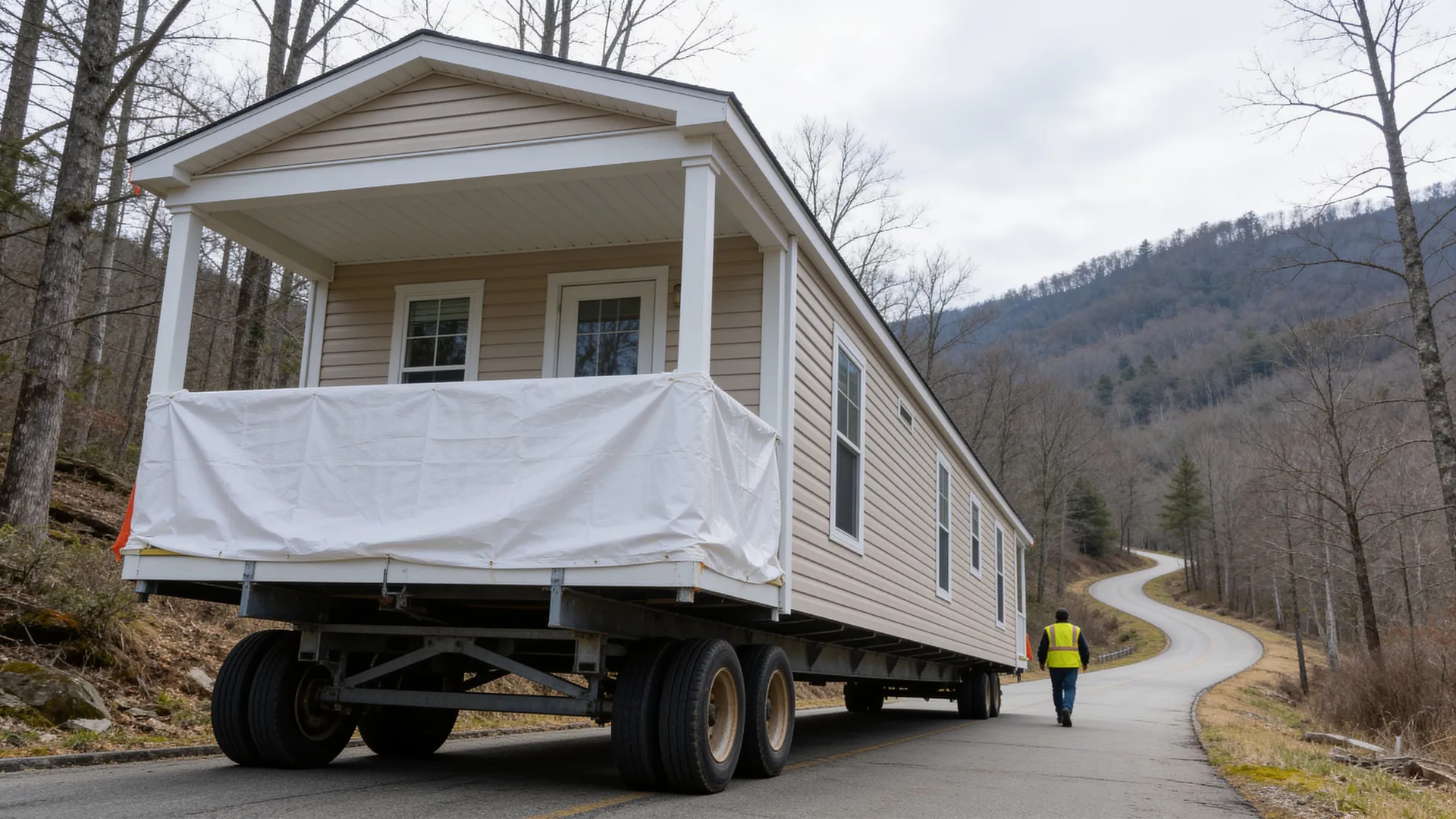
An older manufactured home under tow on a Carolina road — legal to haul, but its build year decides where it can be re-sited
An older home is usually legal to tow. The age question is almost always about where it's allowed to land, not the haul itself.

Line 2 — the mover and the insurer: what we'll tow

Independent of any statute, a mover and its cargo insurer set their own bar, and that bar is really a condition test that tends to correlate with age. A manufactured home flexes under tow — it wants to rack and twist — and an older unit with soft floors, a sagging or rusted-through frame, corroded axles, brittle marriage-line seals, or a failing roof can come apart on the road. That's a safety and liability problem, not a cosmetic one, and it's why reputable carriers and their insurers decline homes they judge too far gone. We don't guess: we run a pre-move structural and running-gear inspection so the decision is based on the actual frame and axles in front of us. Plenty of 30- and 40-year-old homes pass that check and move fine; the ones that don't were never going to survive the trip. This is the honest gate the internet's "there's an age limit" chatter is really pointing at — the truck, not the law.

Line 3 — the destination county: where age caps actually live

This is the line that kills the most moves, and it's local zoning, not transport law. Towing a home is governed by state permit rules; siting it is governed by the receiving county's and town's ordinances. In North Carolina a bare age cap by itself isn't permitted, but — as the UNC School of Government's manufactured-housing-and-zoning summary explains — counties may require HUD-Code (post-June 15, 1976) construction and confine homes to certain districts, which functionally bars a great many older units. And the exact rule changes at every county line: we've documented ordinances as different as Henderson County, Polk County, and Anson County, each with its own age and family-relocation carve-outs. South Carolina works the same way under SC Code § 31-17-360 — the permit gates on paid taxes and disconnected utilities, while the county zoning office decides placement, with Williamsburg and Berkeley Counties among those enforcing a pre-1976 cutoff. The state-by-state framework lives on our North Carolina and South Carolina mobile home moving laws pages. The rule of thumb: confirm the destination county's rule before you spend a dollar on the move.

Line 4 — the park: its own, stricter age rule

If the home is headed into a manufactured-home community, there's a fourth line, and it's usually the tightest of all. A park's incoming-home age limit is a private community standard, separate from and often stricter than the county's — commonly a maximum of 10, 15, or 20 years, paired with condition, siding, and skirting requirements as a condition of accepting the home on a lot. A county might allow a 1998 home while the specific park you're targeting caps incoming homes at 15 years and turns it away at the gate. Because it's a lease-and-community rule rather than a statute, it varies park to park, so we get the community's acceptance rules in writing before we load anything.

So what can you actually do with an older home?

Put the four lines together and the picture is clear. A post-1976 home in good condition is the easy case — legal to tow, insurable, and placeable in most counties and many parks, with the move quoted off distance, size, and condition on our cost to move a mobile home guide. A pre-1976 or badly deteriorated home is the hard case: it's often still towable, but its realistic destinations shrink to relocation on the same parcel, a move to land with no age restriction, or a haul to a salvage or demolition yard. If the home has reached the end of its road, disposal is frequently the smarter spend — that path is on our mobile home demolition page. Either way, the move starts the same: tell us the unit's age and condition and the exact destination, and a licensed Carolinas crew screens all four lines and comes back with a straight answer — find a local mover and we'll tell you whether it moves, where it can land, and what it costs, in one call.

Questions

Mobile home age limits — straight answers

What is the age limit to move a mobile home?
There is no single, universal age limit to move a mobile home — no federal law caps a home at 20, 30, or 40 years old and forbids the haul. In practice four separate lines decide whether an older home actually gets moved: the June 15, 1976 HUD Code date (homes built before it aren't HUD-Code and are widely un-sitable), the hauler's and insurer's own policies (many won't tow a home in poor structural shape), the destination county's zoning, and the receiving park's rules. We look at all four before we quote, because a home can be legal to tow and still have nowhere it's allowed to land — the age problem is almost always a destination problem, not a road problem.
Does a mobile home's age change the cost to move it?
Age doesn't set the price directly, but it drives the two things that do — condition and set-up scope. An older single- or double-wide with a sound frame, good axles, and solid decking moves at a normal rate; the cost climbs when age has left soft floors, a sagging chassis, tired running gear, or brittle marriage-line seals that need extra prep, or when the roof and belly need buttoning up to survive the road. The move itself is quoted off distance, size, and condition — the full picture is on our cost to move a mobile home guide, with the single-wide and double-wide ranges broken out separately. We give you a real number after we see the unit, not an age-based guess.
Can I move a mobile home older than 1976?
You can usually tow a pre-1976 home — road and permit law is about width, weight, and condition, not birth year — but you very often can't legally re-site it. Homes built before June 15, 1976 predate the federal HUD Code (24 CFR Part 3280), so they carry no HUD certification label, and a large share of North and South Carolina counties refuse to permit installation of a non-HUD-Code home outright. That means the realistic moves for a pre-1976 unit are relocation on the same parcel, a move to unzoned land that accepts it, or a haul to a demolition or salvage yard. We unpack exactly what's possible on our can you move a pre-1976 mobile home page.
Is there a mobile home age limit near me — in my North Carolina county?
Age caps in North Carolina are set county by county, so "near me" is the only question that matters. Under NC zoning law summarized by the UNC School of Government, a bare age cap isn't permitted, but counties may require HUD-Code (post-June 15, 1976) construction and confine homes to certain districts — and many effectively bar older units through those rules. We've mapped specific ordinances, including Henderson County, Polk County, and Anson County. Tell us the destination county and we'll confirm its rule before you pay to move anything — full state framework on our North Carolina mobile home moving laws page.
Does South Carolina have an age limit to move a mobile home?
South Carolina works the same way as North Carolina: the state moving statute, SC Code § 31-17-360, gates the haul on paid property taxes and utility disconnection, not on the home's age — but placement is local zoning, and many SC counties enforce an age or HUD-Code cutoff at the destination. Williamsburg County, for example, requires homes to be 1976 or newer, and Berkeley County bars placement of homes built before June 15, 1976. So an older home can clear the § 31-17-360 permit and still be refused a setup permit where it's headed. The full picture is on our South Carolina mobile home moving laws page.
Do mobile home parks enforce their own age limits?
Yes — and a park's age rule is separate from and usually stricter than the county's. Many manufactured-home communities set a maximum incoming-home age (commonly 10, 15, or 20 years) and require skirting, current siding, and a clean exterior as a condition of accepting a home on a lot, even when the county would allow an older unit. That's a private community standard, not a statute, so it varies park to park. Before we move a home into any community, we confirm the park's acceptance rules in writing so the home doesn't arrive to a locked gate.
Why won't some movers or insurers haul an older mobile home?
Because age and condition travel together, and the road is unforgiving to a tired home. A manufactured home flexes under tow, and an older unit with a weak frame, rotted floor, corroded axles, or a failing roof can rack, sag, or come apart in transit — which is a safety and liability problem, not just a cosmetic one. Reputable movers and their cargo insurers decline homes they judge too far gone to survive the haul intact. That's why we run a pre-move structural and running-gear check first: some older homes are perfectly sound and move fine, others don't clear the bar — the road-worthiness question is covered on can a mobile home be moved.
Where does the June 15, 1976 date come from?
That's the effective date of the federal Manufactured Home Construction and Safety Standards — the HUD Code, 24 CFR Part 3280. Homes built on or after June 15, 1976 are constructed to that federal standard and carry a red HUD certification label; homes built before it are pre-HUD "trailers" with no federal construction certification. The date is the single most important line in the entire age question, because zoning ordinances, park rules, lenders, and insurers all use HUD-Code status — not a specific number of years — as the real dividing line between a home that can be placed and one that generally can't.
Keep reading

Older homes, the 1976 line & what it costs

County age rules & older-home paths

County pre-1976 rules and what to do with an old home

Get a quote

Tell us about your move. We price it.

Unit, route, and timeline — that's all we need. Permits, NCDOT-certified escorts, and on-site setup are included in the quote, and you'll hear back within 24 business hours. We never sell or share your info.

Or call 24/7 — (828) 501-2670

Quote in 24 hours

Goes straight to our crew. We don't sell or share leads.